
Haematocrit
You are reading an immutable historical edition recorded on October 26, 2026. This text is permanently preserved for wet-lab citation fidelity. (This is currently the active edition of the treatise). • View full edition timeline & diffs →
Haematocrit
Sometimes, understanding blood simply requires giving it a new spin. Haematocrit measures the proportion of blood volume occupied by erythrocytes, commonly determined by centrifugation. This separates blood into three layers: erythrocytes at the bottom, a thin buffy coat of leukocytes and platelets, and plasma at the top. The packed erythrocyte volume is then expressed as a fraction or percentage of the total blood volume. Sometimes, getting to the bottom of things just takes a good spin.

Haematocrit is the proportion of blood volume occupied by erythrocytes. It is commonly referred to as packed cell volume (PCV) when measured by centrifuging blood and determining the volume of the packed erythrocyte layer. It can be expressed as a volume fraction in litres per litre (L/L) or as a percentage. For example, 0.30 L/L, or 30%, means that erythrocytes occupy approximately 0.30 litres of every litre of blood. It measures their volume fraction rather than their number.
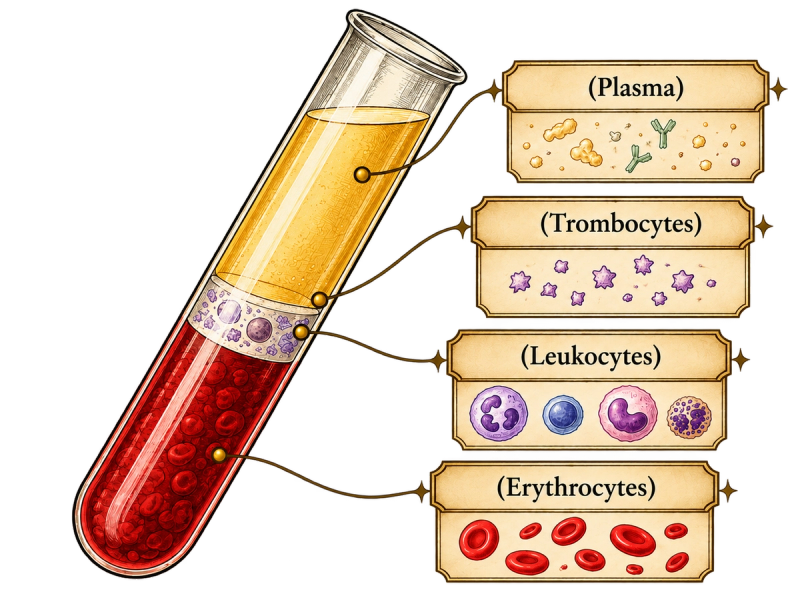
Red blood cells are generally the densest of the main blood components, with a density approximately 1.09 times that of water, compared with about 1.03 times for plasma. Leukocytes generally have a slightly lower density than erythrocytes, although this varies between cell types and with cell age and condition.
Measuring PCV is a relatively simple, inexpensive procedure that can be performed in a laboratory equipped with a suitable centrifuge and capillary tubes. Centrifugation separates anticoagulated blood into three main layers: erythrocytes at the bottom, plasma at the top, and a thin buffy coat containing leukocytes and platelets between them. Beyond measuring PCV, centrifugation also provides a practical way to separate blood fractions for further analysis, although additional processing may be needed to isolate specific cell types.
Sometimes, understanding blood simply requires giving it a spin.